



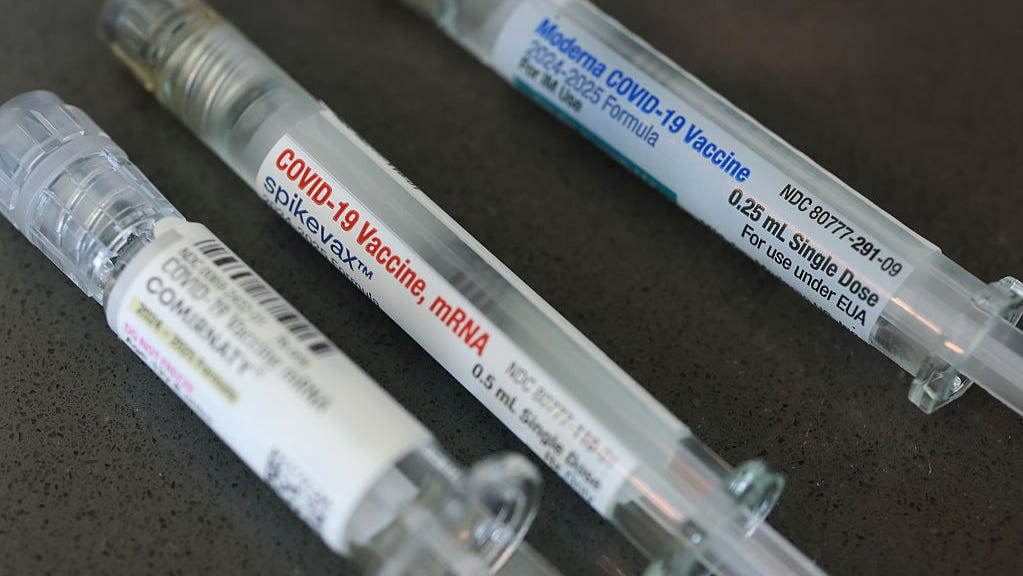


Can I still access the COVID vaccine?
New COVID vaccine guidelines implemented by Health Secretary Robert F. Kennedy Jr. has Americans confused.
- Indiana is among several states with “very high” COVID-19 viral activity at the end of August, according to the CDC.
- The most common COVID-19 variant is XFG, while the NB.1.8.1 variant is associated with an extremely sore throat symptom dubbed “razor blade throat.”
- Health and Human Services Secretary Robert F. Kennedy Jr. has restricted COVID-19 vaccine approval to high-risk individuals and those over 65.
- Professional medical organizations have broken from federal guidance, continuing to recommend the vaccine for children and pregnant women.
COVID-19 case data show Indiana is among multiple states producing “very high” viral activity at the end of the August, according to the Centers for Disease Control and Prevention (CDC).
Some regions of the United States are experiencing higher rates of positive COVID-19 tests than others.
Changing vaccine guidelines and cuts to vaccine development funding have added to the confusion of new COVID-19 strains. The CDC continues to track cases, hospitalizations and deaths on a weekly basis.
Here’s what we know about COVID-19 in Indiana and across the U.S.:
While some people report symptoms like hoarseness or “razor blade throat” as more common with certain variants, health agencies, including the CDC and the World Health Organization, note that there is no evidence of specific symptoms being unique to different strains.
The CDC outlines these common COVID-19 symptoms:
- Congestion or a runny nose
- Cough
- Fatigue
- Fever or chills
- Headache
- Muscle or body aches
- Nausea or vomiting
- New loss of taste or smell
- Shortness of breath or difficulty breathing
- Sore throat
The CDC advises seeking medical care if you experience any of the following symptoms:
- Inability to wake or stay awake
- Depending on skin tone, lips, nail beds and skin may appear pale, gray or blue
- New confusion
- Persistent pain or pressure in the chest
- Trouble breathing
What is ‘razor blade throat’? New variant’s common COVID symptom
An extremely sore throat, or “razor blade throat,” is a symptom currently associated with the new COVID-19 variant − NB.1.8.1.
The new COVID-19 variant was first detected in China back in January.
People with the variant are saying that it feels their throats are covered with razor blades, according to Los Angeles Times, Fox News, SF Gate and other news outlets. Many people have also taken to social media to describe the “razor blade throat.”
“I’ve just had the new variant and the sore throat was awful!” said one person on a Reddit thread. “Started scratchy and went downhill from there.”
It isn’t the first time a symptom like this has been described.
With other strains, people said their throats felt like they had shards of glass jutting out, due to the extreme pain of their sore throats. This symptom, however, is gaining more popularity as the COVID-19 variant spreads.
“Vaccines are expected to remain effective to this (NB.1.8.1) variant against symptomatic and severe disease,” the WHO stated in a May report.
What is currently the most common COVID-19 variant?
The CDC has transitioned to using longer timeframes to release model-based projections about COVID-19 variants because of low reporting from states. According to the latest data projection for the four weeks ending Aug. 30, variant XFG was the most common, accounting for 78% of cases, followed by NB.1.8.1 at 14% of cases and LP.8.1 at 3%.
XFG, a recombination of variants LF.7 and LP.8.1.2, experienced a meteoric rise to become the predominant strain, having been responsible for 0% of U.S. cases through March, 14% by late June, 42% by early July and 60% by early August.
A battle around COVID-19 vaccines is ongoing between regulators, health officials and experts.
On Aug. 27, Health and Human Services Secretary Robert F. Kennedy Jr. announced that emergency-use authorizations for COVID-19 vaccines had been terminated and that the Moderna, Pfizer and Novavax immunizations had been approved only for “those at high risk” and people over 65. This could make it harder for others who want the COVID-19 vaccine to get it, experts warned.
Kennedy had previously stated on May 27 that the COVID-19 vaccine would no longer be included in the CDC’s recommended immunization schedule for healthy children and pregnant women, a move that broke previous expert guidance and bypassed the normal scientific review process.
State health departments and national professional organizations, including the American Medical Association (AMA), American Academy of Pediatrics (AAP) and the American College of Obstetricians and Gynecologists (ACOG), have broken from Kennedy and HHS on these guidelines, suggesting the vaccine for pregnant women and children.
The AAP released its own vaccine recommendations on Aug. 19 in a break from federal guidance shaped by Kennedy.
The AAP schedule recommends that all children ages six months to 23 months receive the latest COVID-19 vaccine to reduce the chance of serious illness. Children and adolescents aged 2 to 18, without other high-risk factors like immunosuppression, can receive and should be offered the vaccine if they were not previously immunized, according to the guidance.
Updated CDC guidelines refrain from making recommendations and instead suggest parents consult with their child’s pediatrician on a case-by-case basis.
US COVID map 2025: Are COVID activity levels high in Indiana? COVID test positivity by region
According to the most recent CDC wastewater data for the week ending Aug. 30, Western and Southern states, including Alabama, Alaska, California, Connecticut, Florida, Hawaii, Idaho, Indiana, Louisiana, Nevada, North Carolina, South Carolina, Texas, Utah, Arkansas, Kentucky, Oregon, Virginia, Washington and Wyoming, plus Washington D.C., had “very high” or “high” levels of COVID-19 viral activity.
According to CDC wastewater data for the week ending Aug. 30, Indiana has 26 sites reporting “very high” COVID-19 activity levels.
How many COVID-19 cases were reported nationwide?
Through the week ending Aug. 30, 10.8% Americans tested were positive for COVID-19, according to the CDC’s latest data. This was a decrease from the prior week (11.6%).
During the same period, 0.6% of cases resulted in death, up from 0.5% the week before, and 1.6% resulted in an emergency room visit, up from 1.5% in the previous week.
Chris Sims is a digital content producer at Midwest Connect Gannett. Follow him on Twitter: @ChrisFSims.
link