


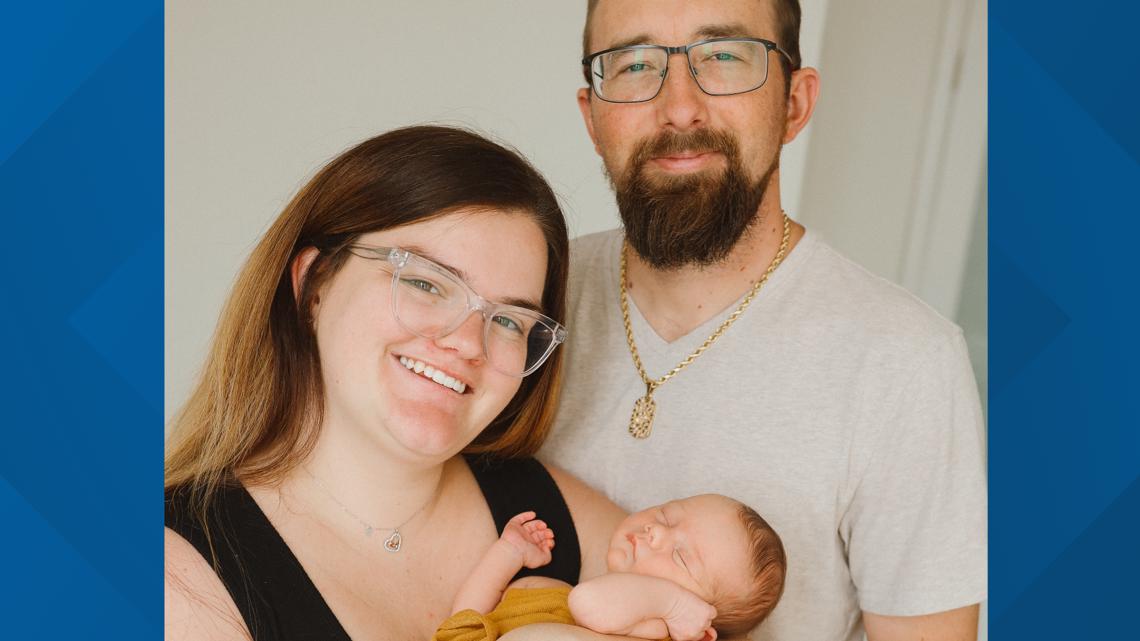
Genetic testing and in vitro fertilization allowed Hazel Sue Payne to be born without polycystic kidney disease.
WHITESTOWN, Ind. — Every couple hopes for a healthy baby. Some of the health problems of our children are genetically inherited from us. A Whitestown couple planned and saved money to make sure their daughter would not carry on a family history of kidney disease.
Hazel Sue Payne is almost three months old, a healthy, happy baby just beginning her new life. But her parents took a long, difficult and expensive journey to bring her into their family.
Marcus and Callie Payne wanted children. They don’t want to pass on the polycystic kidney disease in Marcus’ family. Marcus was born suffering from kidney problems. He needed two kidney transplants as a teenager. He’s 31 now and takes eight pills a day in maintenance medication. There’s a 50% chance of passing down PKD to his children.
“Often there are many family members who have required either dialysis or therapy in the form of a kidney transplant,” said Kevin Schnurr of the PKD-Free Alliance. “And we know, while these are treatments, they’re certainly not cures. The only way to effectively remove PKD from future generations is to go the route we’re discussing.”
That route is genetic testing of embryos before in vitro fertilization, but it’s very expensive. The Payne’s spent about $60,000 to have a healthy baby, and the first embryo transfer failed.
RELATED: ‘Feeling healthy, grateful’ | Greenwood woman donates kidney to mother-in-law
“It’s emotional, especially for us,” said Callie. “We had lost our first round. I’m thinking, ‘What went wrong? Was it me?’ It was a perfect embryo. Our first one was perfect. She was genetically, chromosomally perfect. What happened? And at that time, it must have just been God telling us it’s not time yet. And then you happened.”
Callie is holding Hazel in her arms. Hazel was born May 28, 2025, by C-section. Marcus watched nervously.
Couple plans and saves to eliminate kidney disease from family tree
“When she came out, he said, ‘She’s healthy.’ And you’re just lying there thinking, ‘All the time and all the money, she’s healthy. It worked’,” said Callie.
The PKD-Free Alliance assisted the Payne family with grants of $3,000 and $9,000 to offset the cost of genetic testing and embryo transfer not covered by insurance. The alliance is dedicated to ending PKD by using proven approaches to prevent it from being passed down to future generations. The organization works to educate and support PKD-impacted families and inform the medical community and the public about the solutions and grant funding available to have PKD-free children. The organization was founded in 2022 by Richard Kellner in memory of his late wife, who had PKD.
“It’s a lot of science,” said Schnurr. “It’s a lot of really technical stuff. But the tangible outcome is the healthy baby. And when we see those pictures and hear those great success stories and continue to get updates about how cute these babies are, there’s nothing greater.”
The Paynes would like Hazel to have a little brother. Three more PKD-free embryos remain in storage, only one is male. Out of 16 embryos the couple had tested, only six were PKD-free, and only one is a boy.
The family is saving up to hopefully try a transfer again in the next year or two.
link


More Stories
Russia turns to high altitude balloons after Starlink restrictions disrupt battlefield communications across Russian-controlled territories
What CES 2026 didn’t show: The quiet crisis in wireless capacity nobody is talking about
Recent AWS issues blamed on AI tools – at least two incidents affected some Amazon services