




When they were growing up, Hampton Burnside remembers that his stepsister Susan Fly Allardyce loved New Kids on the Block.
“She used to always watch Nick at Night. She liked ‘Night Court,'” he said. “I didn’t like Nick at Night that much.”
Burnside, who lives about 15 miles outside Shreveport in Haughton, was 9 and his new stepsister was 12 when their parents married. Even back then, he recognized her extraordinary kindness.

Susan Fly Allardyce and Hampton Burnside became step-siblings at 9 and 12.
“We got along from the get-go,” Burnside said.
These days, he admits, he’d probably watch Nick at Night as long as she wanted.
Now, he considers her more than kind. He considers her a miracle.
A disease hiding in plain sight
In March 2024, Burnside thought he had a respiratory infection. Short of breath, he went to the hospital — and discovered his kidneys were in total failure.
“He had no idea that he had kidney disease,” Allardyce said.
There was no reversing the damage. He began dialysis three times a week in Shreveport and had to leave his job with Community Coffee.
“Being a kidney patient is a full-time job,” Allardyce said.

Susan Fly Allardyce and Hampton Burnside.
The symptoms leading up to Burnside’s kidney failure — fatigue, itchy skin, swollen limbs, weight loss — don’t always set off alarm bells.
“Put that together and it doesn’t spell out anything big,” she said. “The symptoms can be confused with something else so easily.”
Burnside, 45, is a single father to two children, ages 9 and 11. He’s their only guardian.
A bond beyond biology
Twenty years ago, Allardyce, who lives in Lafayette, even asked her stepbrother to walk her down the aisle at her wedding. Her father had passed away — and Burnside was family.

Hampton Burnside walked his stepsister Susan Fly (Allardyce) down the aisle 20 years ago at her wedding.
“He is my brother,” she said. “When he got sick, I took it as, not really a sign, but in solidarity with him, I decided to make changes since he had to change his entire lifestyle.”
She cut out fast food, reduced her meat intake and lost 20 pounds.
“I took the opportunity while worrying about my brother’s health to focus on my own,” she said.
To her surprise, by the time she saw her doctor again for a routine checkup, all her numbers were in the normal range.
Months into Burnside’s diagnosis, Allardyce traveled to a family wedding. On the day before the wedding, she went for a long walk. It was a walk that changed everything.
“There were butterflies and birds, and the weather was perfect. I don’t know if it was God that said it to me, but this idea came to me, ‘What if I got healthy so that I can donate? What if all of this was for a purpose?'” she said.
By midnight, she was registered to begin the process of donating a kidney.

Susan Fly Allardyce and Jared Allardyce’s wedding with Hampton Burnside (left of bride Susan).
At first, she assumed she wouldn’t be a match for Burnside. She expected to enter the paired donation program — a system that matches incompatible donor-recipient pairs with others in the same situation, so everyone can get a kidney that fits.
After all, he had not asked her to get tested.
“He was hoping that someone else in his family would go get tested,” she said. “I wasn’t even someone he had thought of because we aren’t blood related.”
But then she got word that their blood types were compatible — she’s A+, he’s A-.
Still, there were other factors to consider.
“His hospital got him to give blood and then snuck me in to give blood and they mixed our blood to see if it would work,” she said. “You could have knocked me over with a feather when they said we were a match.”
She said the match is not as improbable as winning the lottery, but it’s still rare.
“He only had one volunteer. He didn’t have a line of people to donate,” she said. “If you tested a hundred or a thousand people, there may be another match, but are they willing?”
Even once they had matched, challenges remained.
Allardyce learned that 40% of willing donors are disqualified for anatomical reasons alone. Fortunately, even though her left kidney was atypical, surgeons were still able to make it work.
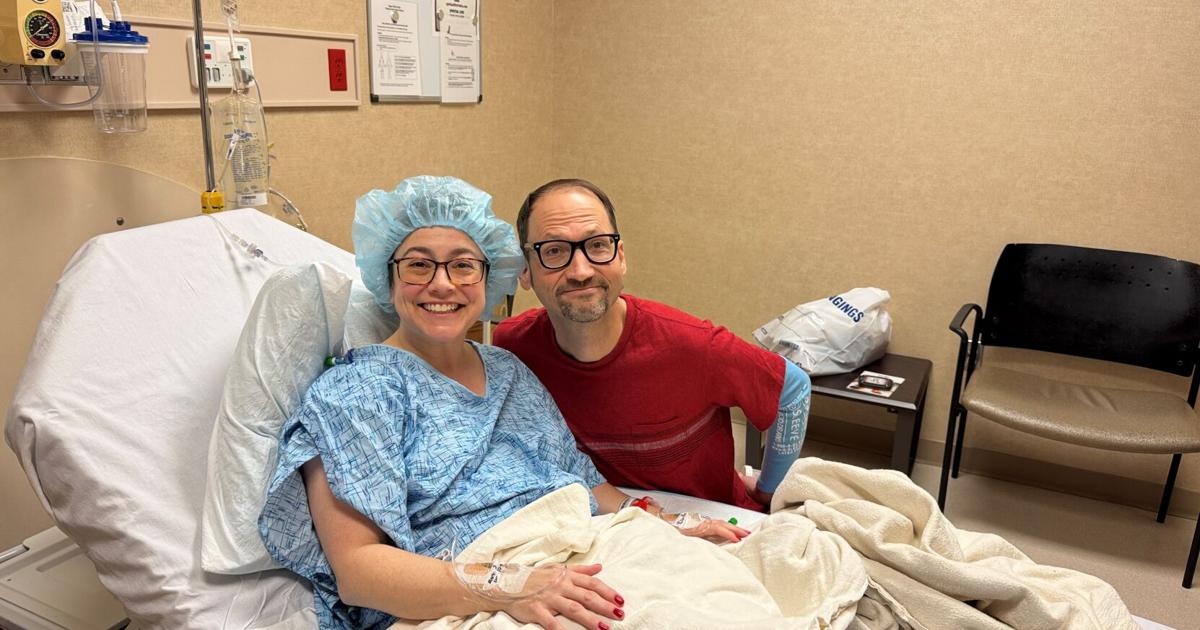
After months of testing and waiting, Allardyce was cleared for surgery.
She shared the news with her family and a few close friends but waited to tell Burnside.
“The night she called me, I had had a terrible day,” Burnside said, his voice cracking. “I get choked up talking about it. She called and said, ‘I’ve got something to tell you.’”

Susan Fly Allardyce on Facetime with her step-brother Hampton Burnside.
Rooted in generosity and love
Now fully recovered, Allardyce says her health is great.
“It’s like nothing ever happened,” she said. “No pain — just a little scar to remind me of what I did.”
Living donor transplants are rare — but growing. Nicole Labadot, executive director of the Legacy Donor Foundation in New Orleans, said the dynamics are complex but rewarding.
“Becoming a living donor is a deeply personal decision rooted in generosity and love,” Labadot said.
And sometimes, it’s the only option for people.
The average wait time for a kidney in Louisiana is five to seven years — more time than many people in need have.
“Anybody on a normal transplant waiting list has to be sick enough to need an organ but well enough to survive a transplant,” Labadot said. “The beauty of being a living donor is that you’re at the optimum health. You’re giving someone an organ functioning at a much higher level than a deceased donor.”
Most living donors, like Allardyce, resume their lives without long-term health effects.
They also receive priority status on the transplant list should they ever need a kidney themselves.
“Living donors like Susan are real-life heroes,” Labadot said. “They give someone a second chance at life.”
‘I get to see my kids grow up.’
At 5:30 a.m. on March 31, Allardyce arrived at Willis Knighton Hospital in Shreveport for the transplant surgery. She expected to be done by noon, though doctors had warned her that her kidney’s unique anatomy might extend the timeline.
The transplant was a success — but the early days of recovery were tough for Burnside.
“My brother is doing much better than he was right after surgery when he was in and out of the hospital,” she said.
Though he had stage 5 level kidney disease before the transplant, Burnside no longer needs dialysis.
These days, he’s focused on raising his kids and looking forward to easing back into work. Nearly three months post-surgery, he’s eager to be around people again.
“I’m night and day from where I was. I get to see my kids grow up,” he said. “I love my sister to death. I can’t put in words how much she means to me. I wrote her a letter, but that’s not enough.”
Allardyce said she doesn’t want her brother to feel like he owes her anything.
She’s asked him to stop saying thank you.
“We’re all ready to find our normal again — and that’s a good thing. We want to be bored,” she said.
Maybe that means they will find time to cue up a little “Night Court” or sing along to some New Kids on the Block.
link


More Stories
Russia turns to high altitude balloons after Starlink restrictions disrupt battlefield communications across Russian-controlled territories
What CES 2026 didn’t show: The quiet crisis in wireless capacity nobody is talking about
Recent AWS issues blamed on AI tools – at least two incidents affected some Amazon services